


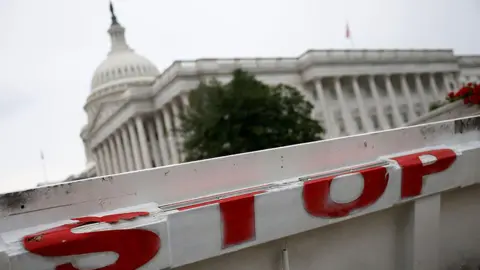
The United States government shutdown has now reached its thirty-sixth day, making it the most prolonged period of federal shutdown in the nation's records.
This shutdown, which started on October 1st, was caused by Congress's inability to reach a budget agreement. This has resulted in government workers without paychecks and millions of Americans lacking critical government services.
Democrats and Republicans have been deadlocked for multiple weeks with no indications of agreement - though faint signs of progress are starting to emerge.
"My feeling is, from my intuition of how these things operate, I think we're approaching an off-ramp here," a senior Republican stated.
The previous closure milestone occurred during Donald Trump's initial presidency and lasted 35 days before it ended in the year 2019.
Increasing Consequences on Americans
In the weeks since this shutdown started, the effects on ordinary citizens have intensified.
Numerous federal workers have not received paychecks, and there are growing fears about impacts to air travel across the US as air traffic controllers and airport staff work without pay.
"Should we reach next week, you will see widespread disruption," a transportation official warned. "Expect mass flight delays. You'll see mass cancellations, and you may see close certain parts of the national airspace, since we just cannot manage it because we don't have air traffic controllers."
Nutrition Benefits Situation
The impacts have particularly affected by economically vulnerable citizens who rely on government services.
Approximately 12.5% of Americans are reliant upon nutrition benefits from the Supplemental Nutrition Assistance Program, but just part of that assistance is being paid out currently due to expired budgetary authorization.
The previous administration had - at first - said no Snap funds would be dispersed in November but federal judges mandated that contingency funds be used to provide citizens partial benefits.
"[Snap benefits] will be given only when the opposition party reopen government, which they can easily do, and not prior to that," the previous administration leader wrote on his preferred platform.
Legislative Stalemate
Members of the US Senate have voted on the same temporary budget measure to reopen the government more than a dozen times with unsuccessful results. They tried again on Tuesday to without success.
That proposal was approved by the House of Representatives in September.
Democrats have thus far declined to back the short-term measure on government funding except if Republicans consented to continue medical coverage assistance for low-income Americans. Republicans have opposed this, claiming their counterparts of using government operations as leverage over unrelated policy priorities.
"Without observing some progress or indications of movement by at least the middle of this week, it becomes difficult to imagine completing anything by the week's conclusion," the senior Republican informed journalists. "And I think that represents the goal here, which is attempting and get something that might be forwarded to the lower chamber that would open up the government."
Over the past few days, there have been signs that some moderate Democrats and Republicans are eager to negotiate and find a deal ahead of the holiday on 27 November.
- Comprehending the US Government Shutdown: Causes and Consequences
- SNAP Benefits: When Will Assistance Persist Through the Government Shutdown?
- Multiple Methods the Federal Closure is Impacting Americans - And How It Might Worsen

